
July 08 : 2025
Liam Man
Utilizing a genius process that Man has not only created but also perfected, his first-place winning image engages with the temporal qualities of light, color, our natural environment, and still imagery. It is a magnificent feat and use of the medium, which will embed itself in the viewer's minds long after they look away.
by Lily Fierman

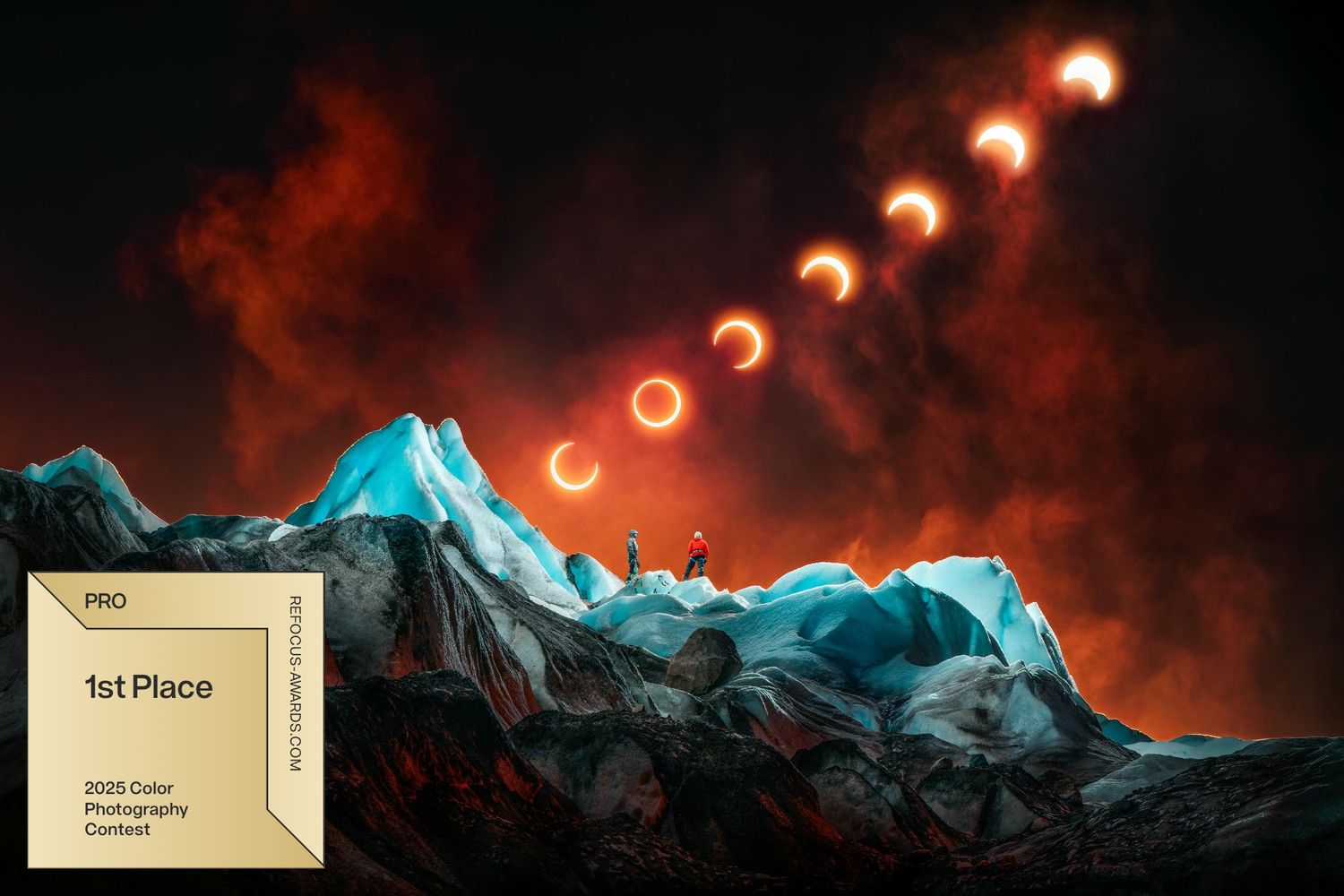
Image: Ring of Fire and Ice
Q:
Can you please tell us more about creating your winning image, “Ring of Fire, and Ice”?
A:
In 2024, I began the "Icebreaker Project", a body of work that seeks to redefine how we appreciate the cryosphere. These alpine and polar worlds are constantly changing and now stand on the brink of extinction. I needed an impactful feature image that would capture both the astronomical power of the sun and its impact on the fragile beauty of ice. That led me to begin studying forecasted solar eclipses, iconic celestial events that represent both cosmic order and fleeting impermanence.
After years of research into eclipse paths and months of scouting, my team and I travelled to the Glacier Leones, one of the fastest retreating glaciers in the world. We spent a week hiking across the ice, searching for a formation where we could align our climbers with the eclipse. The weather was against us. We were battered by rain, snow, and strong winds as we navigated hazardous terrain. With cloud cover threatening to obscure everything, all we could do was get into position and hope.
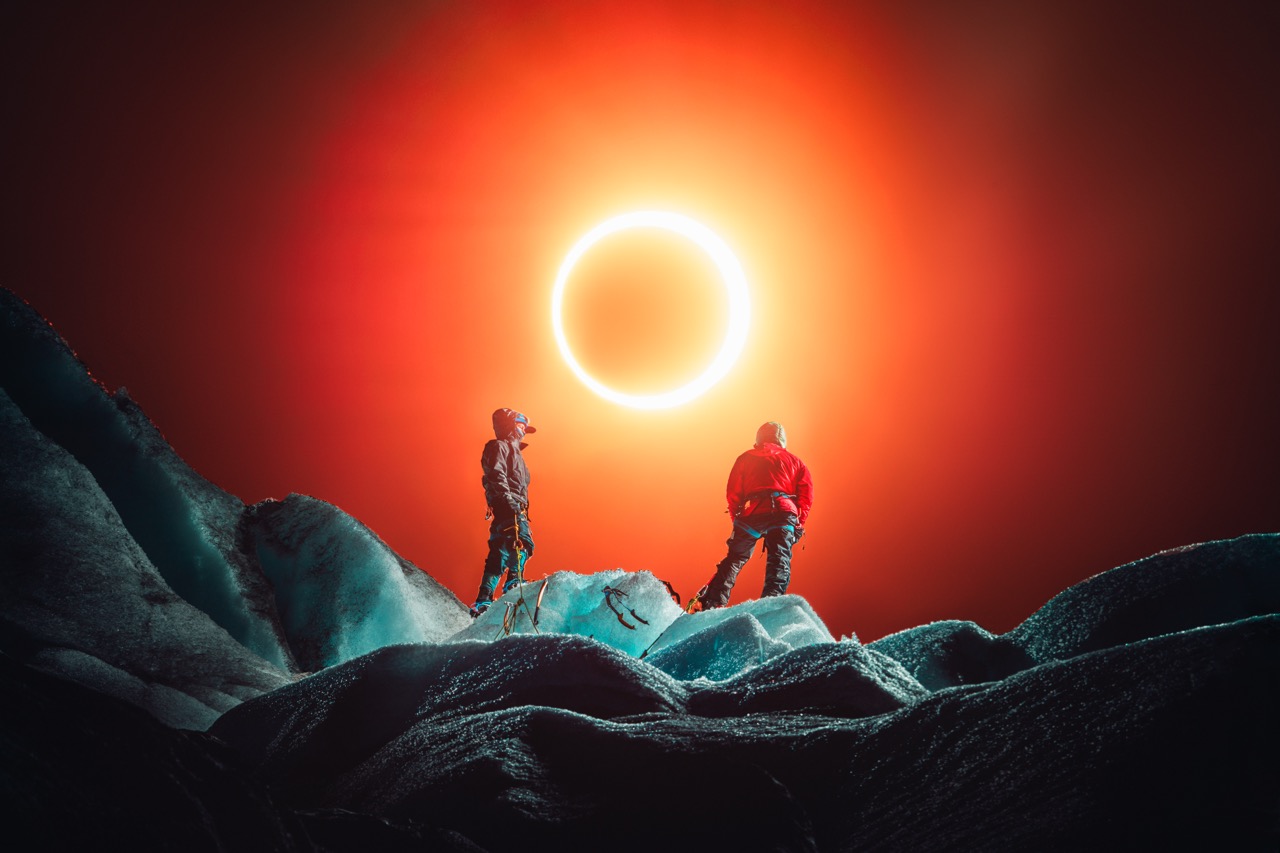
As fate would have it, eclipse day greeted us with perfectly clear skies. It was a huge relief, but the pressure remained intense. Every expense of this expedition was entirely self-funded, and everything rested on a single moment. We got into position and watched in awe as the sun descend towards the horizon and the moon started to obscure it. As we entered the shadow, eclipse winds created by rapid thermal changes in the atmosphere swept across the ridgeline, kicking up snow. Finally, I launched the drone and began to illuminate the glacier, casting light across the ice that would normally be lost in silhouette. This returned shape, texture, and presence to the foreground, allowing the glacier to stand clearly beneath the ring of fire.
Glaciers hold memory, time, and a record of environmental history. To me, photographing them is not just about capturing a landscape; it’s about participating in a conversation about the health of our plant and out place on it.
Q:
There’s something to be said about the ephemeral nature of ice and painting with light. Can you tell us more about the relationship between your style and your advocacy work?
A:
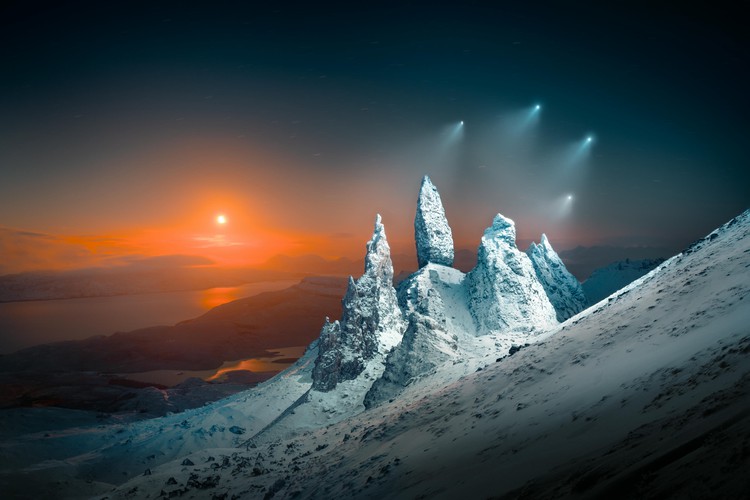
The use of light painting in my work is both a technical choice and a conceptual one. By introducing artificial light into the landscape, I am able to present the scene without the emotional influence of ambient or natural light conditions. It creates a visual neutrality, allowing the landscape to be observed on its own terms. Much like studio portraiture, I can shape this light to highlight the stories that are etched into the landscapes. The light exists only during the exposure, so the resulting image becomes the only way that the illuminated scene can be experienced.
This approach mirrors the nature of glaciers themselves: they are impermanent, constantly changing, and in many places disappearing entirely. Just as the light I use exists only for a brief moment, the world as we know it is vanishing at an alarming rate. Light painting becomes a method of preservation, a way to fix in time something that is transient. Through this process, the work not only documents the landscape but also invites reflection and introspection.
Q:
Why have glaciers become such a big part of your work?
A:
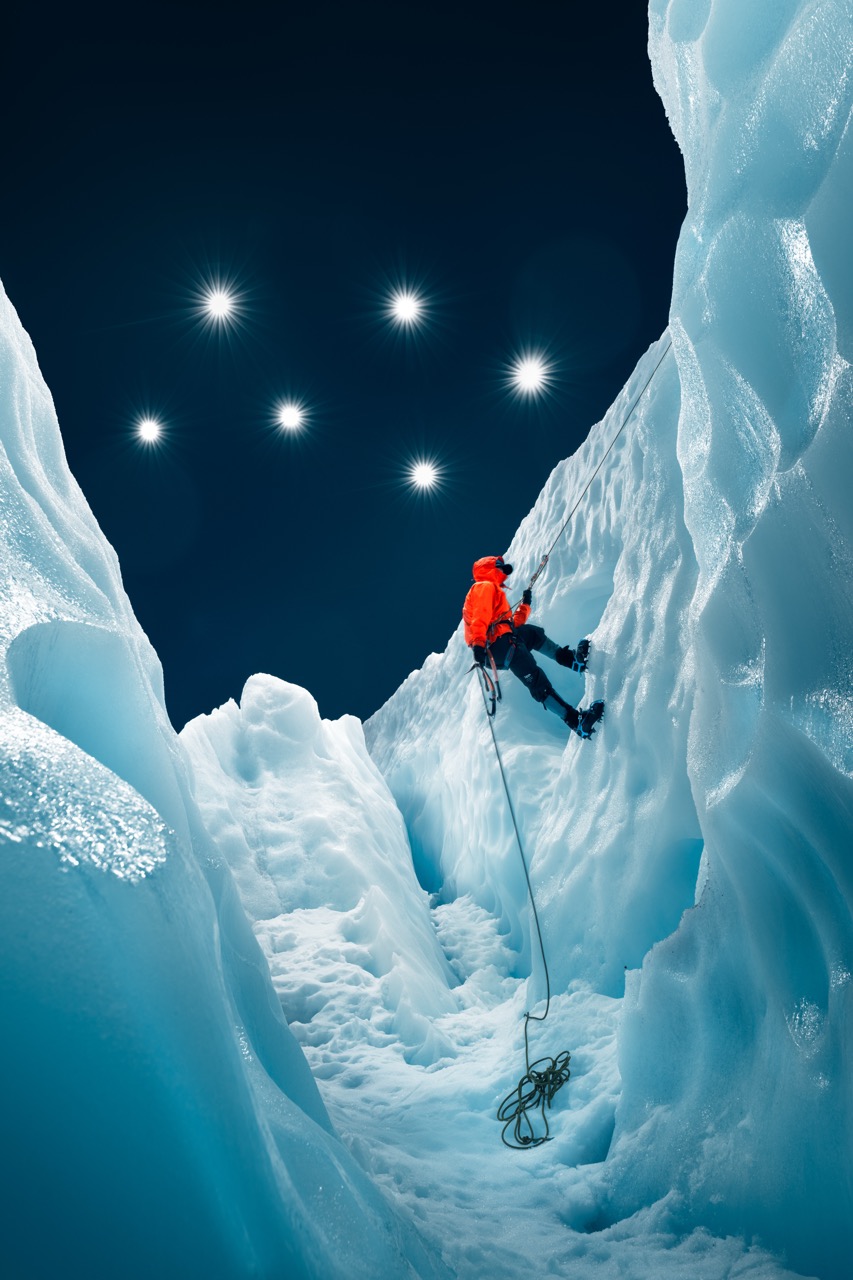
Glaciers are one of the most visible and measurable indicators of climate change. Whilst they are huge solid behemoths that seem fixed in the landscape, they are constantly flowing towards their terminus. That contradiction is compelling. I was initially drawn to them for their scale and form, their soft caps of pure white now and sharp rough spikes when the ice is exposed, but over time the work became more about bearing witness. During my years of travels, I have observed the dramatic changes in the natural world, like the 40 % ice mass loss since 2000 in the European Alps and shifts in the seasonal climates in Swedish Lapland. Glaciers hold memory, time, and a record of environmental history. To me, photographing them is not just about capturing a landscape; it’s about participating in a conversation about the health of our plant and out place on it.

Q:
Can you tell us more about your style, and how you arrived there?
A:
Technologically, my use of drone-mounted lights emerged from practical necessity and creative experimentation. While photographing the night sky during a new moon to maximize the detail in the milky way, I realized that the beautiful landscape I had travelled to was almost entirely devoid of light. I initially tried illuminating it with a handheld flashlight, but with the directionality of the light source limited to my movements, the results were flat and did nothing to celebrate the scene. By mounting the light to a drone, it revolutionized my ability to control the position and intensity of the light with purpose.
This fundamentally shifted how I approached photography. I developed a method that integrates long exposures, aerial light painting, and landscape photography to create images that exist outside of reality. Over time, this approach became central to my practice, a way of shape our understanding of natural forms, adding layers of interpretation to a landscape while staying truthful to its form.
Q:
Why is color photography your main medium?
A:
We experience the world in colour. It plays a critical role in how we emotionally interpret images. In my work, it functions not only as a descriptive tool but also an expressive one. Ice, for example, can take on a surprising range of hues from deep glacial blues to the reds of iron-rich sediments. These variations, which are often missed or flattened in monochrome, tell a story about the geological, chemical and environmental conditions that created them. Colour captures this specificity and avoids flattening these unique features into abstraction.
It also helps distinguish my images from traditional monochrome landscape photography, signaling that this is not just documentation, but an intentional, constructed image. It distances my work from strict photojournalism and places it closer to visual storytelling or environmental portraiture. Colour is vivid and tangible, reminding us that these are real places.

Q:
What are you working on next?
A:
I am continuing to develop the "Icebreaker Project", with many other expeditions scheduled for the new future, as well as photograph other non-glacial related landscapes. I am constantly inspired by diversity of nature and my bucket list of photography locations is already longer than a lifetime of work can achieve. But this does not stop me from adding to it every day and aspiring to create environmental portraits of all the natural wonders of the world.
Artistically, I am exploring new ways to present the work in more immersive multi-disciplinary formats and as technology advances in drone and lighting design, I plan to stay at the forefront of this generation of artists, sharing stories that are currently unknown to the general public.
Q:
Who are some of the photographers you admire?
A:
I greatly admire Joel Sartore. His long-term vision and discipline in constructing the "Photo Ark" project, and ability to create a unified, recognizable visual language while working across thousands of species is remarkable. Beyond the photography itself, I respect his use of images not only as visual art or records of biodiversity but as tools for education, advocacy, and public engagement. It’s a reminder that impactful photography extends beyond the frame.
I also love Jimmy Nelson’s for the similar way that it documents cultures at risk of being lost. His portraits are carefully composed, aesthetically rich, and made in deep collaboration and respect with the communities he photographs. His work raises important questions about heritage, representation, and the passage of time. Both photographers show that long-form visual storytelling, when done with intention and clarity, can leave a lasting mark on how we see and value the world.
ARTIST