Passage
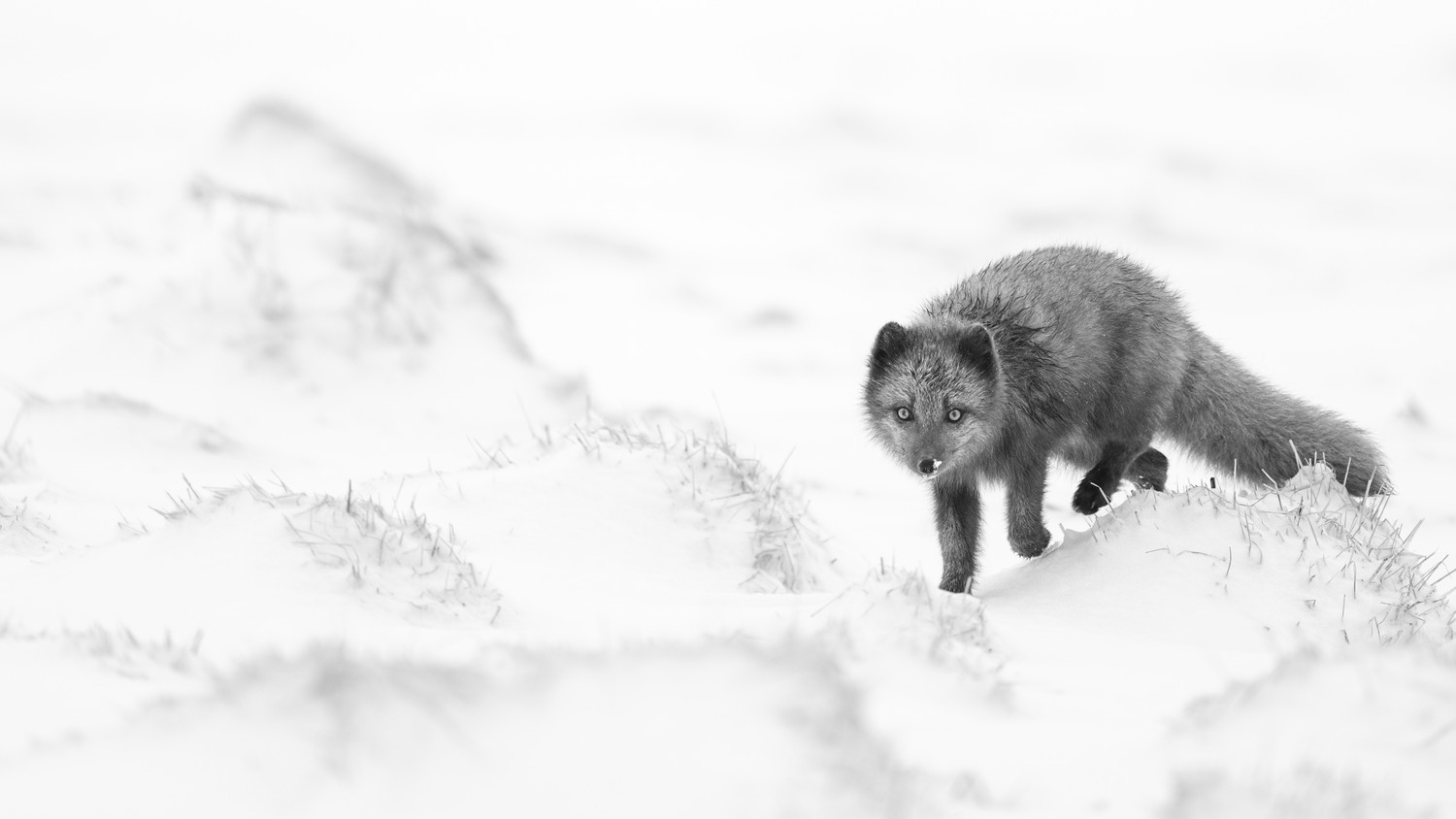
An arctic fox threads its way forward—neither hurried nor still, but with the steady rhythm of instinct. The whitened field blurs boundaries between path and place, yet the fox moves with quiet certainty.
Passage
An arctic fox threads its way forward—neither hurried nor still, but with the steady rhythm of instinct. The whitened field blurs boundaries between path and place, yet the fox moves with quiet certainty.
Awards
Black & White Photo Contest
2025Nominee
Wildlife
Non Professional
Passage
An arctic fox threads its way forward—neither hurried nor still, but with the steady rhythm of instinct. The whitened field blurs boundaries between path and place, yet the fox moves with quiet certainty.
About Artist
Miles Hewitt-Boorman
My practice investigates the conditions through which presence becomes perceptible—and the moments when presence suspends those conditions entirely. I work in environments where visibility is conditional: polar coastlines where snow and mist flatten the world into tonal field, landscapes where reflections hold more substance than their sources, intertidal zones where form is twice daily redistributed by tide. These places function not as backdrops but as active participants in what can be seen. I return to these sites not because they illustrate ideas I already hold, but because they resist them. The work begins where visibility falters, where presence cannot be assumed, and where looking requires sustained attention. Whatever emerges in the images is discovered there, not brought to it. High-key monochrome operates as method rather than aesthetic. It strips context, isolates tonal architecture, and reveals the transitions through which form emerges from field or dissolves back into it. Long exposures compress duration into single frames, making visible the slow negotiations between persistence and erasure that often escape attention. Most of the work operates at the edge of perception, where subjects must be actively discerned rather than assumed. At times, however, that instability gives way to confrontation: an animal may occupy the frame with a weight that refuses abstraction, look back, and hold the gaze. The practice moves between these modes—the conditional and the undeniable—proposing that seeing is never passive, whether presence must be searched for or simply met. I grew up on the Cornish coast, where the tidal edge taught me to read thresholds. That training now shapes how I approach environments where boundaries are never fixed.
Explore Other Winners
View All